Eulerian Cycles
Problem 289
Let C(x,y) be a circle passing through the points (x, y), (x, y+1), (x+1, y) and (x+1, y+1).
For positive integers m and n, let E(m,n) be a configuration which consists of the m·n circles:
{ C(x,y): 0 ≤ x < m, 0 ≤ y < n, x and y are integers }
{ C(x,y): 0 ≤ x < m, 0 ≤ y < n, x and y are integers }
An Eulerian cycle on E(m,n) is a closed path that passes through each arc exactly once.
Many such paths are possible on E(m,n), but we are only interested in those which are not self-crossing: A non-crossing path just touches itself at lattice points, but it never crosses itself.
Many such paths are possible on E(m,n), but we are only interested in those which are not self-crossing: A non-crossing path just touches itself at lattice points, but it never crosses itself.
The image below shows E(3,3) and an example of an Eulerian non-crossing path.
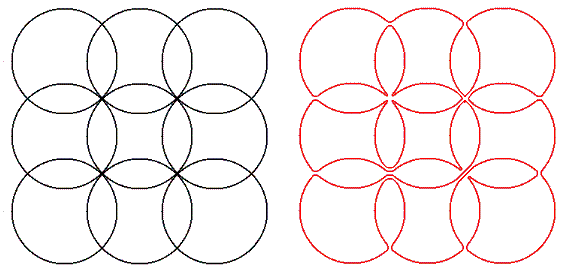
Let L(m,n) be the number of Eulerian non-crossing paths on E(m,n).
For example, L(1,2) = 2, L(2,2) = 37 and L(3,3) = 104290.
For example, L(1,2) = 2, L(2,2) = 37 and L(3,3) = 104290.
Find L(6,10) mod 1010.