Cube digit pairs
Problem 90
Each of the six faces on a cube has a different digit (0 to 9) written on it; the same is done to a second cube. By placing the two cubes side-by-side in different positions we can form a variety of 2-digit numbers.
For example, the square number 64 could be formed:
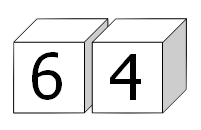
In fact, by carefully choosing the digits on both cubes it is possible to display all of the square numbers below one-hundred: 01, 04, 09, 16, 25, 36, 49, 64, and 81.
For example, one way this can be achieved is by placing {0, 5, 6, 7, 8, 9} on one cube and {1, 2, 3, 4, 8, 9} on the other cube.
However, for this problem we shall allow the 6 or 9 to be turned upside-down so that an arrangement like {0, 5, 6, 7, 8, 9} and {1, 2, 3, 4, 6, 7} allows for all nine square numbers to be displayed; otherwise it would be impossible to obtain 09.
In determining a distinct arrangement we are interested in the digits on each cube, not the order.
{1, 2, 3, 4, 5, 6} is equivalent to {3, 6, 4, 1, 2, 5}
{1, 2, 3, 4, 5, 6} is distinct from {1, 2, 3, 4, 5, 9}
{1, 2, 3, 4, 5, 6} is distinct from {1, 2, 3, 4, 5, 9}
But because we are allowing 6 and 9 to be reversed, the two distinct sets in the last example both represent the extended set {1, 2, 3, 4, 5, 6, 9} for the purpose of forming 2-digit numbers.
How many distinct arrangements of the two cubes allow for all of the square numbers to be displayed?
from itertools import combinations


def run():
    arrangements_count = 0

    # just iterate over all possible digits combinations on the 2 cubes (there are not so many of them)
    for c1, c2 in combinations(combinations(range(10), 6), 2):
        s1, s2 = set(c1), set(c2)

        # if either 6 or 9 were chosen, we add both of them
        for s in s1, s2:
            if 6 in s or 9 in s:
                s.add(6)
                s.add(9)

        # check that we can form all 2-digit square numbers
        for d1, d2 in ((0, 1), (0, 4), (0, 9), (1, 6), (2, 5), (3, 6), (4, 9), (6, 4), (8, 1)):
            if not ((d1 in s1 and d2 in s2) or (d1 in s2 and d2 in s1)):
                break
        else:
            arrangements_count += 1

    return arrangements_count